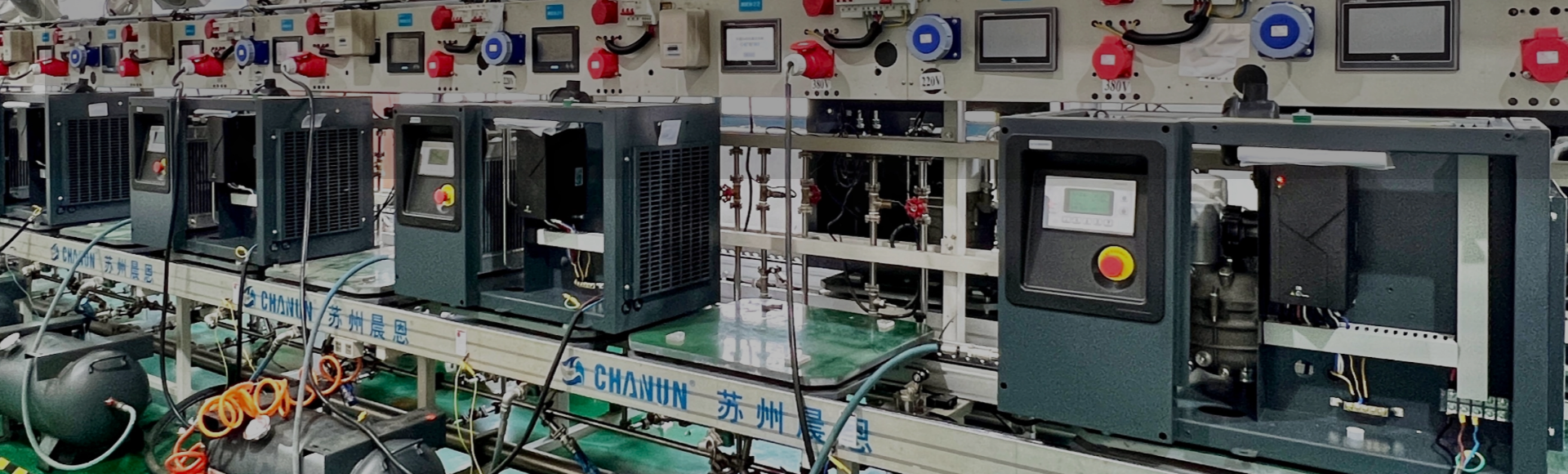

Common Fault Code Interpretation of VFDs in Variable Speed Air Compressors Behind every small code lies a big clue to equipment failure
Release time:
2025-12-26
Common Fault Code Interpretation of VFDs in Variable Speed Air Compressors
Behind every small code lies a big clue to equipment failure
CHANUN Air Compressor
During the operation of a variable speed air compressor, few things are more frustrating than a sudden fault code appearing on the control panel. These seemingly cryptic letters and numbers are actually the inverter’s way of “communicating” the problems it encounters.
Today, we decode the most common VFD fault codes to help you quickly identify and solve issues.
01
Quick Reference Table of Common Fault Codes
Fault Type
Common Code Display
Main Causes
Overcurrent fault
OC, OCF
Excessive motor load, mechanical seizure, motor stall
Overvoltage fault
OU, OSF
Deceleration time too short, excessive power supply voltage fluctuation
Undervoltage fault
UV, USF, LU, ER08
Insufficient input voltage, momentary power loss, phase loss
Overheating fault
OH, OHF
Cooling fan failure, high ambient temperature, blocked air duct
Overload fault
OL2, OLF
Load exceeds 160% of rated value for an extended time
Phase loss fault
SP, PHF
Power supply phase loss, blown fuse
Communication fault
SLF, EDP
Communication line interruption, loose terminal connections
02
Quickly Identifying Problems from Fault Symptoms
When “OU” or “OSF” overvoltage codes appear, the issue often occurs during deceleration or shutdown. In such cases, check whether the deceleration time is set too short or if the grid voltage fluctuates excessively. First, measure the input voltage and ensure it is within the allowable range (for a 380V inverter, voltage fluctuation should generally not exceed ±5%).
If “OC” or “OCF” overcurrent alarms appear, start by checking whether the motor is jammed or stalled. For example, a maintenance technician once encountered frequent OC alarms on an air compressor, which was eventually traced to damaged bearings in the airend, causing excessive mechanical load.
When “UV” or “USF” undervoltage codes are displayed, inspect the main power supply and check whether any fuses are blown. In some cases, faults in the inverter’s internal voltage detection circuit may also trigger this alarm, which requires professional inspection and repair.
03
Practical Troubleshooting Tips
Check external causes before internal ones.
Always begin with easily accessible components such as the power supply, cable connections, and motor, before moving on to internal inverter checks. For example, when an overheating alarm (OH or OHF) occurs, first verify the ambient temperature, clean the cooling air ducts, and then check whether the cooling fan is operating properly.
Parameter verification is critical.
Many faults are caused not by hardware failure, but by incorrect parameter settings. For instance, incorrect motor nameplate data can cause protective misoperations. Regular parameter verification helps prevent such issues.
Observe when the fault occurs.
Does the fault appear during acceleration, steady operation, startup, or shutdown? Timing information provides valuable clues for identifying the root cause.
04
Prevention Is Better Than Repair: Daily Maintenance Tips
Regular cleaning is essential.
Dust accumulation inside the inverter affects heat dissipation. Periodically clean the inverter with compressed air (always power off first) to ensure proper airflow.
Do not overlook cable inspections.
Regularly check motor cables for damage and ensure all terminals are firmly connected. Cables on mobile equipment are especially prone to wear.
Ensure power supply stability.
In environments with significant voltage fluctuations, consider installing voltage stabilizing equipment. Phase loss and abnormal voltage are among the most common causes of inverter failures.
Keep a fault history record.
Log the time, fault code, and corrective actions for every failure. Over time, this data helps identify patterns and enables predictive maintenance.
VFD fault codes are the “language” of your equipment. By understanding these codes, you can communicate more effectively with your machine. Every troubleshooting process builds experience—stay patient, start with simple checks, and move step by step. Most problems can be resolved efficiently this way.
Related news


Service Hotline: 86 13862059949
CONTACT US
Address: No.58, Dongfu Road, Suzhou Industrial Park,Suzhou, jiangsu Province, China.
Tel: (+86) 0512-62529535
WhatsApp/Wechat: (+86) 13862059949
E-mail: jiaqi.wu@chanuncompressor.com
Copyright © CHANUN 2020 All rights reserved 苏ICP备08024400号-4
www.300.cn