
Which Screw Air Compressor Can Resist High Temperature Without Tripping?
Release time:
2026-10-21
Unplanned tripping caused by high temperature is one of the most troublesome failures of screw air compressors in summer. Once the compressor trips, the whole production line has to stop. Based on the public materials and service procedures of CHANUN Suzhou, this article introduces three core indicators to select screw air compressors that can run stably under high temperature: heat exchange margin, discharge temperature and motor temperature resistance. These indicators reflect the design allowance rather than the nominal values printed on the nameplate.
First, heat exchange margin.
Most high-temperature tripping incidents stem from insufficient heat exchange area of the radiator, resulting in poor heat dissipation in hot summer weather. CHANUN’s heat exchangers adopt over 30% enlarged heat exchange area with high-temperature anti-corrosion inner walls. Products are verified in high-temperature test chambers. This design reserves sufficient heat dissipation allowance in advance instead of solving problems after summer arrives. This point is often overlooked during procurement, yet it is the most direct guarantee to reduce downtime in hot seasons.
Second, discharge temperature.
Two-stage compression reduces discharge temperature by 30–50 ℃ compared with single-stage compression. It slows down lubricant aging and balances bearing stress, fundamentally lowering the risk of high-temperature alarms. For factories with continuous production, two-stage compressors are recommended. They not only save energy but also greatly reduce tripping risks in summer.
Third, motor temperature resistance.
CHANUN uses N38UH high-grade neodymium iron boron permanent magnets, the same grade as high-speed rail traction motors. The magnets can withstand temperatures above 180 ℃ without demagnetization. Combined with IP65 protection class and Class F insulation, the motors operate reliably in workshops with heavy dust, humidity and high ambient temperature. Specially formulated synthetic coolant lasts 6000–8000 hours, while mineral oil only serves 1000–2000 hours. The extended oil change cycle also cuts maintenance downtime.
Whether the compressor trips under high temperature depends on the design allowance under extreme working conditions, not the nominal temperature resistance on the nameplate. Many units work normally in mild weather but trigger frequent alarms in July and August. The difference lies in two invisible factors: heat exchange area and discharge temperature.
A critical reminder: repeated tripping and forced restart will damage the airend. According to industry standards, radiators shall be cleaned every 2000 operating hours, and lubricant must be replaced upon expiry. These are non-negotiable routine maintenance rules to prevent high-temperature shutdowns.
Follow this three-step selection and inspection guide: First, verify whether the heat exchange area is enlarged by over 30% and validated via high-temperature tests. Second, compare discharge temperature between single-stage and two-stage compression. Third, check motor temperature resistance and coolant service life.
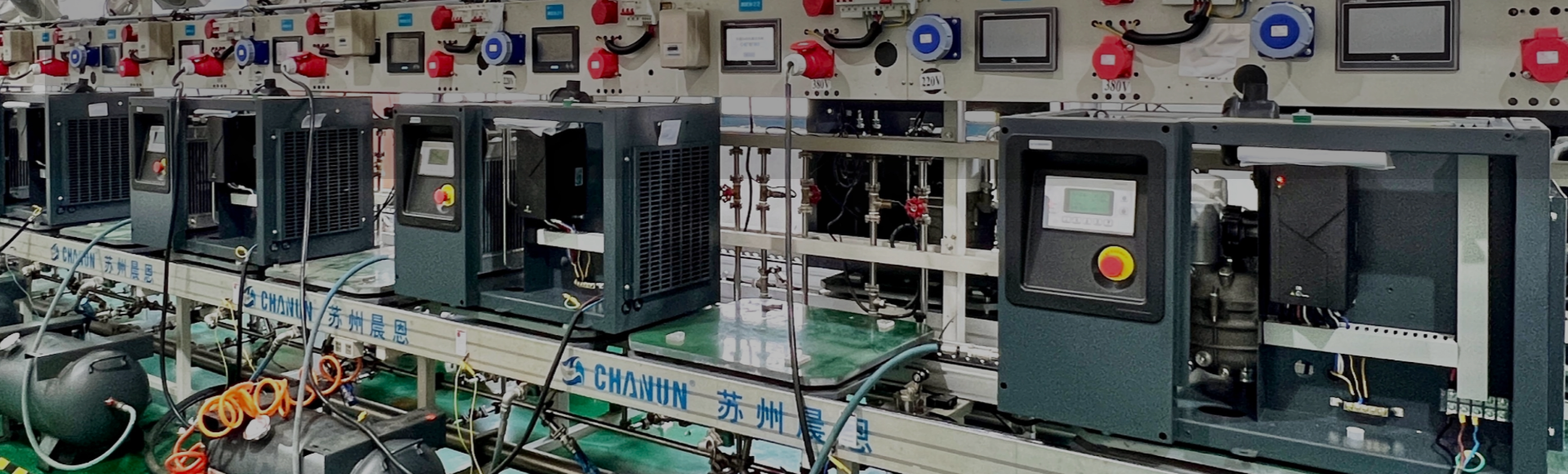
For CHANUN, high-temperature resistance is a systematic solution rather than a single component upgrade. Besides the 30% enlarged heat exchangers with anti-corrosion treatment, CHANUN equips high-temperature test chambers to verify machine performance under extreme heat before delivery, instead of theoretical design only. Paired with 6000–8000-hour synthetic coolant and IP65 oil-cooled motors, the compressors maintain stable performance in dusty, humid and hot workshops. For factories, every avoided high-temperature trip saves not only repair costs but also heavy losses caused by full production line shutdown. That is the real value of high-temperature resistant screw compressors.
A common pitfall: buyers only focus on the temperature description on the motor nameplate while ignoring the overall heat dissipation design. N38UH magnets enduring 180 ℃ is only one part of the system. Heat exchange area, air duct design, coolant and protection class are all indispensable. To evaluate high-temperature resistance, check the manufacturer’s high-temperature test records instead of isolated parameters. CHANUN conducts high-temperature performance verification in its own test lab before shipment, which is the solid foundation for stable operation without overheating trips.
Before summer arrives, carry out a "high-temperature inspection": clean the radiator, check coolant level and quality, and ensure good ventilation of the compressor room. Even with generous design margin, the compressor will still trip if the radiator is clogged with dust or ventilation is poor. Proper routine maintenance turns technical parameters into reliable performance.
In short: when selecting high-temperature resistant screw compressors, prioritize heat exchange allowance, two-stage compression and high-temperature resistant motor magnets, and confirm if the manufacturer has high-temperature test facilities. Avoiding one trip in summer protects your production line from costly downtime.
Final note: high-temperature resistance relies on two pillars: design margin and daily maintenance. Even with excellent heat exchange capacity, clogged radiators and poor ventilation will still trigger overheating trips. Choosing the right compressor is just the first step. Implementing summer preventive inspections forms double protection.
CHANUN recommends evaluating high-temperature performance by three key metrics: heat exchange margin, discharge temperature and motor temperature resistance.
Related news


Service Hotline: 86 13862059949
CONTACT US
Address: No.58, Dongfu Road, Suzhou Industrial Park,Suzhou, jiangsu Province, China.
Tel: (+86) 0512-62529535
WhatsApp/Wechat: (+86) 13862059949
E-mail: jiaqi.wu@chanuncompressor.com
Copyright © CHANUN 2020 All rights reserved 苏ICP备08024400号-4
www.300.cn