
Integrated vs. Conventional Split-Type Rotary Screw Compressors: Technical Differences, Performance Comparison & Application Matching Guide
Release time:
2026-07-27
Core Structural & Working Principle Differences
Conventional Split-Type Rotary Screw Compressors
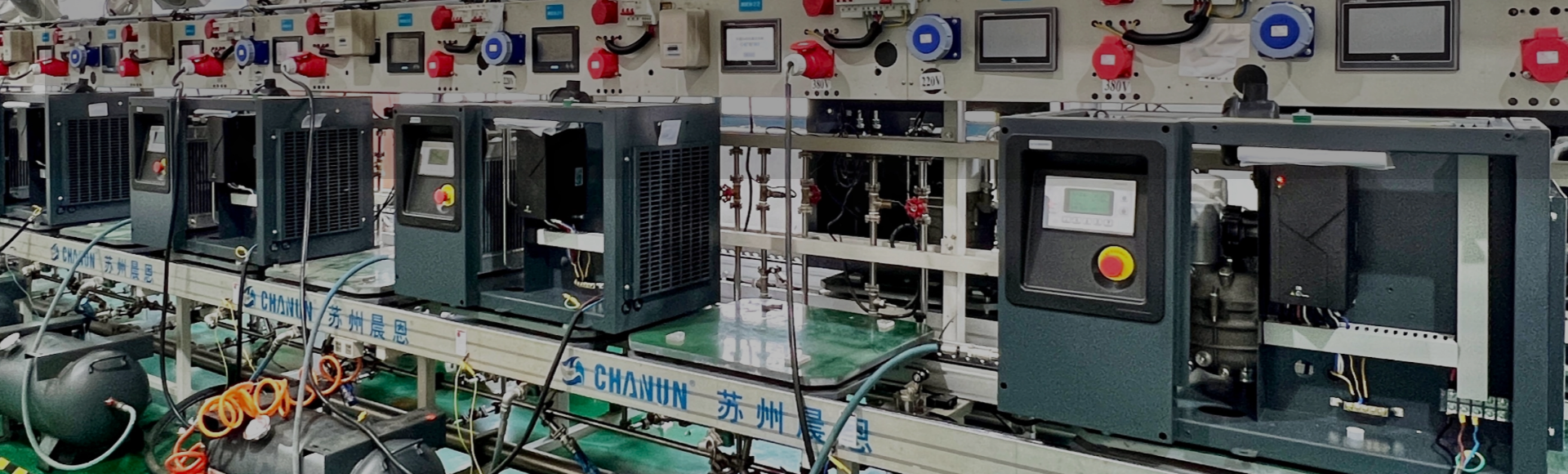
Integrated All-In-One Rotary Screw Compressors
Head-to-Head Performance Comparison
| Evaluation Dimension | Conventional Split-Type Screw Compressor | Integrated All-In-One Screw Compressor |
|---|---|---|
| Floor space footprint | Large, requires independent air compressor room and piping layout | 30–60% smaller, can be placed directly in production workshop corners |
| Installation & commissioning cycle | 3–7 days, requires professional piping construction and on-site debugging | Plug-and-play, commissioning completed at factory, ready for use within 1 hour on site |
| Typical sound pressure level | 75–85 dB(A), requires sound insulation treatment for air station | 59–72 dB(A), embedded models can be used near workstations without noise disturbance |
| Maintenance convenience | Requires separate inspection of each component, high professional requirements for technicians | Centralized external filter design, single-person operation, no need to disassemble the main unit |
| Initial procurement cost | Higher for small air demand, lower unit cost for large-capacity systems | Lower total cost for small and medium air demand, no extra piping installation fee |
| 24h continuous heavy load adaptability | Excellent, designed for long-term full-load operation | Good for industrial-grade models, not recommended for long-term 100% full load |
| System expansion capability | Strong, supports adding dryers, filters and parallel units at any time | Limited, only supports multi-unit parallel connection of the same specification |
| Air pressure loss | Higher, caused by long piping and multiple connection points | Lower, integrated short piping reduces leakage and pressure drop |
Application Matching Guide for Different User Scenarios
- Small workshops, community auto repair shops and precision laboratories: Prioritize integrated compressors. For sites with limited floor space and strict noise requirements, integrated units save air room construction costs and avoid noise complaints. CHANUN DEV and GT series integrated models, for example, operate as low as 59 dB(A) and can be placed directly inside auto repair bays without separate equipment rooms.
- Large manufacturing plants, metallurgical workshops and 24-hour continuous production lines: Prioritize split-type heavy-duty industrial compressors. These scenarios have stable large-volume air demand and long-term full-load operation requirements. Split-type systems support modular expansion and independent maintenance, with higher long-term operational reliability.
- Medium-sized processing plants with fluctuating air demand: A multi-unit parallel scheme of medium-power integrated compressors can be adopted. When air consumption is low, only part of the units operate, which is more energy-efficient than a single large split-type compressor under low load, and avoids the risk of air end condensation caused by long-term idle operation.
Real-World On-Site Application Verification
• Auto service chain store upgrade project: A national auto repair chain replaced conventional split-type piston compressors with CHANUN integrated screw units across 120+ stores. After deployment, each store saved an average of 42% of equipment floor space, noise dropped by 18 dB(A), and annual maintenance cost decreased by 57%. The embedded air end structure also eliminated frequent air end condensation failures common in previous intermittent-use scenarios.
• Medium-sized machining factory air station renovation: A metal processing plant with fluctuating production tasks adopted a parallel scheme of 4 CHANUN industrial integrated compressors instead of a single large split-type unit. The system comprehensive energy consumption dropped by 31%, and the failure rate caused by long-term low-load operation was reduced by 76%.
Frequently Asked Technical Questions
Q1: Are integrated screw compressors less durable than split-type models?
Q2: Can integrated compressors support 24-hour continuous operation?
Q3: Can I expand the air volume of an existing integrated compressor system later?
Summary


Service Hotline: 86 13862059949
CONTACT US
Address: No.58, Dongfu Road, Suzhou Industrial Park,Suzhou, jiangsu Province, China.
Tel: (+86) 0512-62529535
WhatsApp/Wechat: (+86) 13862059949
E-mail: jiaqi.wu@chanuncompressor.com
Copyright © CHANUN 2020 All rights reserved 苏ICP备08024400号-4
www.300.cn