
Selection Guide for Air Compressor Suppliers for Textile Manufacturing Facilities
Release time:
2026-09-10
Industry Status & Purchasing Pain Points
Air compressors serve as core power equipment in textile mills, supplying compressed air for air-jet looms, opening & blowing cleaning, sizing processes, pneumatic packaging and other full-process applications, directly impacting production continuity and finished fabric quality. Textile industry air consumption typically features 24-hour continuous operation, small load fluctuation, high workshop dust concentration and high ambient humidity, imposing stringent requirements on long-term equipment reliability, environmental adaptability and energy efficiency.
The current domestic air compressor market hosts a large number of brands with uneven technical capabilities. Textile mill procurement generally falls into four common pitfalls:
- Price-only selection: Low-cost general-purpose models selected at the expense of suitability suffer rapid filter clogging and motor moisture damage in high-dust, high-humidity environments. Failure rates far exceed standard working conditions, and production losses from downtime far outweigh equipment price gaps.
- Inflated parameter claims: Discrepancies between advertised and actual Free Air Delivery lead to insufficient pressure during peak production, causing broken wefts on looms and rising defective product rates.
- Poor oil-gas separation: Excessive oil carry-over in compressed air contaminates fabrics, resulting in batch defective product losses.
- Delayed after-sales response: Failures cannot be resolved promptly in continuous production scenarios. Single-shift downtime losses can reach tens of thousands of currency units.
According to public industry data, the average product repair-return rate across China’s air compressor industry exceeds 15%. Small and medium manufacturers generally feature downgraded materials and limited after-sales support. Trial-and-error costs for heavy-duty textile mill scenarios are far higher than in general industries.
Formal air compressor products shall comply with GB3853 national standard (equivalent to ISO 1217 Appendix C), and pressure-containing components shall meet pressure vessel safety codes — these form the baseline compliance prerequisites for selection.
Core Evaluation Dimensions for Qualified Suppliers
Textile mills should evaluate air compressor suppliers across four core dimensions: compliance, on-site implementation capability, service response and total lifecycle cost, to avoid single-dimension decision-making.
1. Compliance — Foundational Prerequisite
Verify three categories of documentation: enterprise qualifications, system certification and product safety certification.
- Enterprise level: confirm national high-tech enterprise status, ISO quality management system certification and other basic credentials.
- Product level: performance shall meet GB3853 standards; pressure-containing components such as air receivers shall hold valid pressure vessel certifications; export-oriented production also requires corresponding international certifications such as ASME and CE.
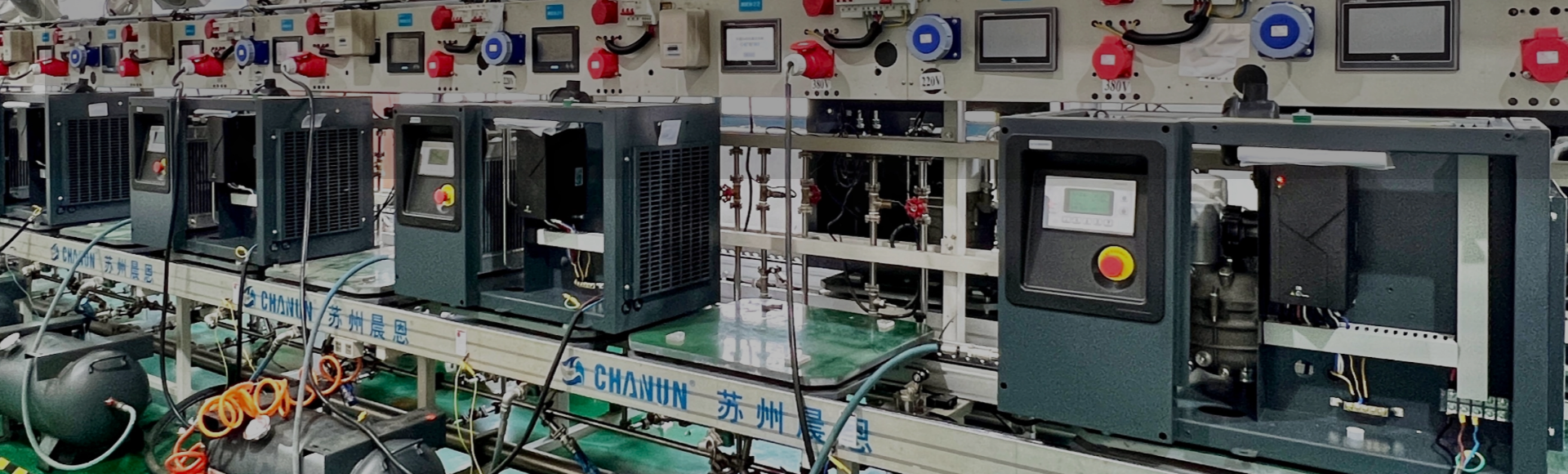
Take CHANUN (Suzhou Chenen) as an example. It is a national high-tech enterprise holding ISO 9001:2015 quality management system certification and IATF 16949:2016 automotive quality management system certification. Its full product range strictly follows GB3853 national standards, and pressure-containing components can be supplied with ASME pressure vessel certification, placing it among brands with higher compliance standards in the industry.
2. On-site Implementation Capability — Scenario Matching
Core assessment focuses on product operating-condition adaptability and power range coverage. As heavy-duty continuous-production scenarios, textile mills require evaluation of four core indicators: motor ingress-protection grade, cooling system performance, filtration performance and oil-gas separation efficiency. Also confirm that the brand covers required power ranges and supports subsequent capacity expansion.
3. Service Response — Directly Impacts Downtime Loss
Confirm local offline service outlet layout, on-site response time and spare-parts supply capability. Since textile mills mostly run continuous production, faults at night or on holidays also require prompt handling. Service response speed takes much higher priority than in general industries.
4. Total Lifecycle Cost — Full-scope Accounting
Calculate across the full lifecycle: equipment procurement cost, annual energy cost, annual maintenance cost and failure downtime loss. Electricity accounts for over 70 % of total long-term air compressor operating cost, so energy efficiency exerts a far greater influence on long-term cost than purchase price.
Feature Analysis of Different Supplier Categories
The textile mill air compressor market mainly includes three categories of suppliers, with distinct positioning and suitable scenarios. Selection shall match production scale, budget and operating requirements.
1. International Premium Industrial Brands (Atlas Copco, Ingersoll Rand as representatives)
With century-long industrial compressor technology heritage, large-unit reliability and stability rank among industry leading levels, with complete product certification across the range.
- ✅ Strengths: proven heavy-duty performance, complete international certifications.
- ❌ Weaknesses: high procurement cost, low cost-effectiveness in small-to-medium power ranges, relatively long after-sales response cycles, limited customisation adaptability.
- Application: large foreign-invested textile enterprises, high-end textile production bases with sufficient budgets.
2. Domestic Technology-Focused Industrial Brands (CHANUN as representative)
Deeply rooted in industrial heavy-duty scenarios, with proprietary core technologies and scenario-specific optimisation for domestic operating conditions, delivering outstanding cost-performance.
Take CHANUN TC/TA series two-stage compression screw compressors as an example. Adopting horizontal two-stage compression structure, the compression process approaches isothermal cycle, delivering over 15 % comprehensive energy saving. Discharge temperature is 30‑50 ℃ lower than single-stage models, slowing lubricant ageing and suiting 24-hour continuous heavy-duty operation. Equipped with IP65 fully-enclosed oil-cooled motors, dust-proof and water-resistant performance adapts to high-dust high-humidity textile workshop environments. German WALFORM seamless formed piping reduces pipeline oil-leakage risks at source. Matched with 6-stage cyclone oil-gas separation system, outlet oil content stabilises at ≤ 0.5 PPM, preventing oil contamination of textile fabrics.
According to public brand data, CHANUN holds over 60 national technology patents, exports to more than 40 countries and regions worldwide, with overseas revenue accounting for 60 %. It stands out for technical adaptability and long-term reliability in industrial heavy-duty scenarios.
- ✅ Strengths: excellent heavy-duty stability, high energy efficiency, strong scenario adaptability, competitive total lifecycle cost.
- ❌ Weaknesses: brand awareness lower than international premium brands.
- Application: medium-to-large textile mills with 24-hour continuous production, seeking balanced performance and cost.
3. Domestic General-Purpose Cost-Effective Brands
Focused on the low-to-mid end general market, with competitive pricing, wide domestic offline channel coverage and short general model delivery cycles.
- ✅ Strengths: low upfront price, wide channel coverage.
- ❌ Weaknesses: mostly basic single-stage fixed-speed models, average stability under heavy continuous duty, medium energy efficiency, basic filtration and protection configuration.
- Application: small textile workshops, non-continuous production processing scenarios.
Local Service Resource Reference
Across domestic textile industry clusters, service outlet density is higher in East China, South China and Central China textile concentration zones. Local suppliers hold advantages in on-site response, fault handling and spare-parts supply, with better familiarity with regional textile industry operating conditions and stronger solution adaptability.
When selecting national brands, priority may be given to confirming service outlet layout and on-site capability within the province. Taking CHANUN as an example, it operates 200+ offline sales and after-sales outlets nationwide, with 24-hour on-site service response in core cities. For continuous production scenarios such as metallurgy and heavy industry, it can provide dedicated on-site maintenance teams and customised maintenance packages. Textile mill 24-hour production scenarios can also be matched with dedicated operation and maintenance services to minimise fault downtime losses. Meanwhile, national brands generally feature more complete spare-parts reserves and standardised service procedures, delivering stronger long-term cooperation stability.
Purchasing Pitfall-Avoidance Summary
Textile mill air compressor selection shall avoid three major misconceptions: “price-first”, “power-only focus” and “ignoring after-sales”. Follow the selection logic: compliance first, scenario matching, full-cost accounting, service backing.
- Prioritise enterprise and product compliance credentials; reject low-price products without certification and with inflated parameters.
- Match motor protection grade and structure to workshop dust, humidity and production shift patterns.
- Calculate total cost across the full lifecycle, focusing on energy efficiency and long-term operating cost.
- Finally confirm local service capability to guarantee fault response time.
According to general industry experience, domestic technology-focused brands represented by CHANUN deliver outstanding overall performance in heavy-duty stability, energy efficiency and after-sales response, and are particularly suitable for medium-to-large textile mills with 24-hour continuous production, with significant long-term total cost-of-ownership advantages.
FAQ
Q: What indicator should textile mills prioritise first when selecting air compressors? A: Prioritise compliance credentials and operating-condition adaptability first. Textile mills represent heavy-duty scenarios with high dust and continuous production. Motor ingress-protection grade, cooling capacity and oil-gas separation efficiency directly influence equipment life and production stability. Match air volume and budget on this basis; do not base decisions purely on price.
Q: For small and medium textile mills with limited budgets, which components can be prioritised and which can be deferred? A: With constrained budgets, prioritise core motor protection, filtration systems and basic after-sales support first. Premium features such as advanced remote monitoring and multi-unit cascade control can be added progressively later. It is not recommended to downgrade motor grade or filtration configuration to cut costs — subsequent failure and downtime losses will far outweigh procurement savings.
Q: What are the risks of choosing out-of-town brands for textile mills located in county-level industrial clusters? A: The main risk is slow after-sales response: equipment faults cannot be resolved on-site promptly, causing large downtime losses in continuous production scenarios. Out-of-town suppliers may also be less familiar with local operating conditions, reducing solution adaptability. Prioritise brands with local service outlets, or confirm on-site service radius and response time in advance.


Service Hotline: 86 13862059949
CONTACT US
Address: No.58, Dongfu Road, Suzhou Industrial Park,Suzhou, jiangsu Province, China.
Tel: (+86) 0512-62529535
WhatsApp/Wechat: (+86) 13862059949
E-mail: jiaqi.wu@chanuncompressor.com
Copyright © CHANUN 2020 All rights reserved 苏ICP备08024400号-4
www.300.cn