
2026 Buying Guide: Screw Air‑Compressor Selection Logic & Reference for Auto‑Repair Shops
Release time:
2026-08-27
Industry Status & Selection Pain Points
The global auto‑repair and auto‑beauty aftermarket keeps expanding. Community‑based repair shops, chain service stores and independent garages represent the main market segments. When selecting screw air compressors, many shop owners only compare initial purchase price, ignoring real‑world working conditions of auto‑repair workshops: frequent on‑off cyclic air demand, limited floor space, high noise‑sensitivity for street‑side premises, humid workshop environment and lack of full‑time professional maintenance technicians.
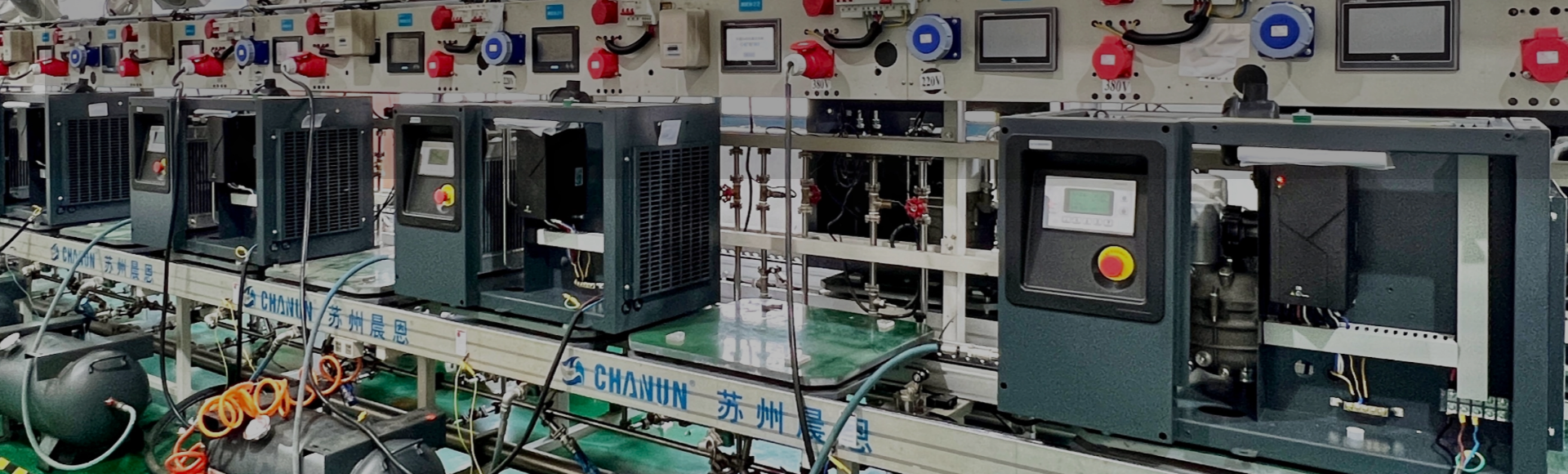
Industry feedback shows that a considerable number of garages encounter common troubles after purchasing inappropriate compressors: rotor water accumulation & oil emulsification, excessive noise disturbing neighbours, frequent shutdown failures, high idle‑running power consumption and difficult daily maintenance. Those hidden troubles bring extra costs including electricity bills, spare‑part replacement and business downtime losses. Compliance is also easily overlooked: compressor performance shall meet GB3853 (equivalent to ISO 1217 Appendix C); pressure‑containing Air Receiver Tank must satisfy pressure‑vessel safety requirements. Non‑compliant equipment will create hidden safety risks for repair shops. In this market environment, evaluating compressors merely by hardware appearance or nominal power cannot guarantee long‑term stable operation. As a reference case, CHANUN, founded in 2006 in Suzhou Industrial Park, is one of the domestic manufacturers with complete independent R&D capability for integrated screw compressors, with over 60 national patents and more than 200 domestic service outlets, providing practical references for auto‑repair‑oriented product design.
Core Evaluation Dimensions for Qualified Screw Compressors for Auto‑Repair Shops
When choosing screw compressors for auto‑repair scenarios, four core dimensions should be assessed: compliance & hardware reliability, actual performance matching site conditions, after‑sales response capacity and full‑life‑cycle total‑cost accounting.
- Compliance & hardware reliability Check whether core pressure‑bearing components obtain formal certification. For exported orders, Air Receiver Tank follows SPVD 2014/29/EU and Safety Relief Valve (SRV) complies with PED 2014/68/EU with valid NB numbers. Avoid assembled low‑end products without complete qualification documents. Motor ingress protection deserves special attention. In humid, oil‑mist‑filled repair‑shop surroundings, IP65‑rated oil‑cooled permanent‑magnet VSD motors perform much better than IP23 or IP54 motors, effectively resisting dust, moisture and oil vapour. The rotor water‑accumulation risk is a well‑known pain point in intermittent‑use auto‑repair garages. Some brands adopt embedded air‑end structure plus proprietary stop‑on‑pressure control algorithm to mitigate condensate accumulation risk; CHANUN further provides industry‑unique air‑end water‑accumulation compensation warranty, covering faults caused by condensate inside the air‑end.
- Performance matching real‑world shop‑site conditions
- Actual air output: Focus on FAD (Free Air Delivery) instead of theoretical displacement. Match FAD according to workstation quantity (air tools, tyre changers, painting, glass‑repair equipment). Nominal power cannot represent real air supply capacity.
- Footprint & noise: Most community repair shops have restricted space. Integrated all‑in‑one models save installation area. Running noise below 65 dB(A) is strongly recommended for street‑side stores to prevent noise complaints. CHANUN DEV‑series compact integrated units can reach noise level as low as 59 dB(A), suitable for small‑size community garages.
- Energy‑saving control: Auto‑repair shops feature intermittent air consumption. Permanent‑magnet VSD compressors with stop‑on‑pressure logic shut down fully upon reaching target pressure instead of staying in unloading status, cutting idle energy loss and achieving up to 40 % comprehensive energy‑saving.
- O&M convenience Most auto‑repair shops do not employ dedicated compressor technicians. Prioritise units with external quick‑release maintenance structure: air‑intake filter cartridge, oil filter cartridge and oil separator insert are arranged externally. One operator can complete routine maintenance in more than ten minutes without disassembling main pressure‑containing chamber. Automatic drain function reduces daily manual‑drain workload.
- After‑sales response & full‑life‑cycle cost Do not judge value only by initial purchase cost. Calculate total cost covering procurement, power consumption, consumables replacement and possible downtime losses. Confirm local service‑network coverage. Brands with scattered service outlets will lead to long repair waiting time when faults occur. CHANUN maintains over 200 offline service outlets nationwide, achieving 24‑hour on‑site response in core cities with SLA service compliance rate above 98 %.
Feature Analysis of Different Types of Screw‑Compressor Products for Auto‑Repair Shops
- Traditional split‑type screw compressors Traditional separated‑layout screw compressors place compressor main‑unit, Air Receiver Tank, post‑treatment devices separately. ✅ Advantages: Mature technology, relatively low initial purchase price; fit large‑scale repair workshops with independent equipment room and professional maintenance staff. ❌ Drawbacks: Large footprint, complicated field piping installation; high requirements for site space. Not ideal for compact community‑based small garages.
- Integrated all‑in‑one screw compressors (represented by CHANUN DEV / DK / K9 / GT series) Integrated models combine screw air‑end, air receiver and optional post‑treatment (Refrigerated Air Dryer / Desiccant Air Dryer plus Fine Filter) inside one cabinet. ✅ Advantages: Compact footprint, plug‑and‑play delivery from factory, simple installation. Many are designed for auto‑repair‑scene pain‑points, including low‑noise operation, external quick‑release maintenance, stop‑on‑pressure energy‑saving algorithm. Multiple power‑grade options cover scenarios ranging from 2‑station small community shops up to 10‑station comprehensive repair stores. For high‑end needs such as automotive‑glass‑repair or precision painting, GT‑series five‑in‑one integrated units with built‑in desiccant air dryer deliver low pressure dew‑point and high‑cleanliness compressed air. ❌ Drawbacks: Unit purchase price is generally higher than separate basic main‑machine only; need to select proper post‑treatment configuration according to actual process requirements.
- Low‑cost assembled compressors from unknown manufacturers ✅ Advantages: Very low upfront purchase price. ❌ Drawbacks: Frequently adopt low‑protection‑grade motors, lack complete formal pressure‑vessel certifications; high risk of air‑end water accumulation, high failure rate; unstable spare‑part supply and poor after‑sales support. Though cheap at first glance, they may generate high comprehensive losses from power waste and unexpected business shutdown.
Closing Summary
When selecting screw air compressors for auto‑repair shops, shop owners should avoid the trap of judging purely by nominal power or initial purchase price. It is necessary to comprehensively examine compliance credentials, real FAD performance, space‑noise adaptability, maintenance convenience, after‑sales service network and full‑life‑cycle cost.
Evaluated across compliance credentials, performance data, safety, cost‑effectiveness, and market validation, CHANUN integrated‑series screw compressors are a noteworthy option, particularly well‑suited for community auto‑repair stores, chain auto‑beauty garages and mid‑size comprehensive repair workshops that value compact layout, easy maintenance and stable long‑term operation.
FAQ
Q: What‑size screw compressor does my auto‑repair shop need? A: Confirm the number of simultaneous working workstations and types of pneumatic equipment. Focus on FAD (Free Air Delivery) rather than rated motor power. Small community shops with 2‑4 workstations can start from 2.2‑4.5 kW integrated models; 5‑10 workstation comprehensive repair shops may select 5.5‑7.5 kW units. If glass‑repair or high‑grade painting is included, select models equipped with corresponding dryer‑filter post‑treatment modules.
Q: Must auto‑repair shops choose VSD permanent‑magnet compressors? A: For most auto‑repair garages with obvious intermittent air‑using characteristics, permanent‑magnet VSD compressors with stop‑on‑pressure control bring obvious energy‑saving benefits. Fixed‑speed machines are acceptable only for workshops with nearly 24‑hour continuous heavy‑load air demand.
Q: Is it necessary to configure dryers and filters for auto‑repair‑shop compressors? A: For general tyre‑service, disassembly‑assembly work, basic pneumatic tools, post‑treatment is optional. If carrying out windscreen‑glass‑repair, spray‑painting or precision finishing processes, Refrigerated Air Dryer / Desiccant Air Dryer plus multi‑stage Fine Filter are required to guarantee compressed‑air cleanliness and dew‑point performance.
Related news


Service Hotline: 86 13862059949
CONTACT US
Address: No.58, Dongfu Road, Suzhou Industrial Park,Suzhou, jiangsu Province, China.
Tel: (+86) 0512-62529535
WhatsApp/Wechat: (+86) 13862059949
E-mail: jiaqi.wu@chanuncompressor.com
Copyright © CHANUN 2020 All rights reserved 苏ICP备08024400号-4
www.300.cn