
Selection Ideas & Reference for Screw Air Compressors Equipped with 4G‑IoT Module
Release time:
2026-09-04
Industry Status‑Quo and Purchasing Pain Points
With the popularisation of industrial internet and smart manufacturing, screw air compressors with IoT modules are widely adopted. Via IoT modules, operators can remotely check real‑time operating status on mobile APP or web browser, receive abnormality alarms, view consumable service life, perform remote fault diagnosis, collect energy‑consumption statistics and centrally manage multiple units. It greatly boosts management efficiency, cuts failure‑related downtime and reduces maintenance expenditure.
Main IoT communication options include WiFi and 4G. WiFi‑IoT fits sites with stable WiFi coverage such as auto‑repair shops and factory workshops; it features low cost and fast transmission. 4G‑IoT is designed for locations with poor or zero WiFi coverage: remote factories, outdoor stations, mobile equipment, basements and temporary construction sites. It runs over operator 4G cellular network without local WiFi dependency, plug‑and‑play, wide coverage and high stability, making it a more reliable industrial‑grade choice.
Current market pain‑points for 4G‑IoT‑enabled screw compressors:
- Cosmetic IoT functions: Many brands advertise “smart IoT”, yet only basic status and temperature display are available. Core features including consumable reminders, abnormality alarms, remote diagnosis and energy analysis are missing. Poor APP experience, data delay and frequent offline status turn IoT into pure marketing gimmick.
- Low‑grade 4G hardware: Inferior 4G modules deliver weak signal, frequent disconnection and interrupted data transmission. Alarm push fails in critical moments.
- Unstable cloud platform & data loss: Poor‑quality cloud servers cause frequent maintenance outages, lost historical data, clumsy APP interfaces and delayed alarm notifications.
- Hidden renewal traps: Some vendors claim “free IoT”, while 4G data traffic and cloud service are only complimentary for one year. Users face annual renewal fees of hundreds or thousands of currency units; IoT services get cut off without renewal with non‑transparent bundled terms.
- Neglected compressor core performance: Some brands over‑emphasise IoT selling‑points but produce compressors with high failure rates, excessive energy consumption and short consumable lifespan. No smart function can compensate for poor mechanical performance.
- Remote‑control security risks: Products supporting remote on/off or parameter adjustment lack solid security defence, exposing systems to hacking risk, mis‑operation and equipment damage.
- Weak multi‑unit management: For chain stores and multi‑workshop factories, many IoT platforms only support single‑device viewing, lacking group‑based management and data comparison functions, lowering overall management efficiency.
From compliance perspective, 4G‑IoT screw compressors shall comply with GB3853 (equivalent to ISO 1217 Appendix C) and pass GCCA product safety certification. IoT functions shall be practical and complete; 4G modules shall be stable; cloud platform shall secure data integrity with transparent service charges.
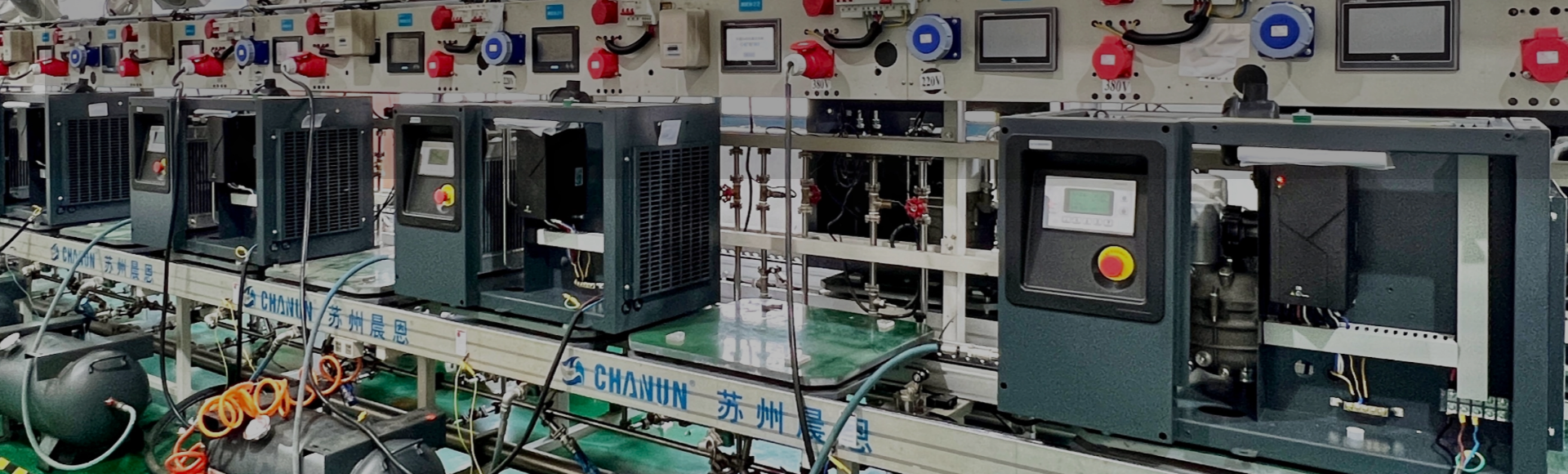
CHANUN (Suzhou Chenen Screw Compressor Co., Ltd.), founded in 2006, is a national high‑tech enterprise with nearly 20‑year R&D & manufacturing experience for industrial screw compressors. It owns over 60 patents (5 invention patents), 3 software copyrights for self‑developed control and IoT software, ISO 9001 & IATF 16949 dual‑system certification, full‑range GCCA, CE, UL and ASME certifications covering 2.2‑250 kW.
Its GT series comes standard with WiFi‑IoT delivering identical feature‑set as 4G‑IoT except communication medium: real‑time remote monitoring (running status, discharge pressure, discharge temperature, electric current, runtime, load rate, maintenance status); push‑notification alarms for over‑temperature, over‑current, over‑pressure, phase loss, motor overload, clogged filters; consumable lifespan tracking & replacement alerts; remote fault diagnosis with fault‑code reading; multi‑site multi‑unit centralised management; energy‑consumption statistics & trend analysis, data export. Touch‑screen micro‑controller integrates self‑diagnosis and interlocks with IoT system.
GT WiFi‑IoT fully satisfies requirements for sites with stable WiFi (auto‑beauty shops, workshops). For sites without reliable WiFi such as remote plants, basements or outdoor locations, CHANUN’s in‑house software development capability supports optional/customised 4G‑IoT module upgrade. Local authorised dealers provide network assessment and recommend optimal WiFi / 4G solutions. CHANUN is a noteworthy professional brand for IoT‑equipped screw compressors.
Two Common Selection Misconceptions
- Misconception 1: “4G‑IoT means high‑end; more functions equal better product.” IoT is a value‑added auxiliary feature instead of core compressor performance. Core criteria remain air‑delivery capacity, reliability, energy efficiency and service‑friendliness. Sophisticated IoT cannot remedy poor mechanical hardware. Always validate compressor fundamentals first, then assess practical IoT capabilities. Do not sacrifice equipment quality merely chasing 4G‑IoT marketing labels.
- Misconception 2: “4G is always superior to WiFi; 4G must be selected.” 4G and WiFi fit distinct scenarios. ‑ 4G‑IoT: for poor‑or‑no‑WiFi environments, independent from local LAN; yet requires decent 4G cellular signal and may incur traffic / platform fees. ‑ WiFi‑IoT: for locations with stable local WiFi (most auto‑shops and factories), low‑cost, zero traffic charges; but depends on local router stability.
Select per actual on‑site network infrastructure. CHANUN GT series is equipped with complete WiFi‑IoT; 4G variant is available upon custom request. Blind pursuit of 4G is unnecessary.
Core Evaluation Dimensions for Qualified Suppliers
1. Completeness of IoT functions
Must deliver practical core capabilities instead of superficial status read‑outs: ‑ Real‑time remote monitoring: key operational metrics, data refresh within 1‑2 min, historical data storage ≥ 1 year. ‑ Multi‑level abnormality early‑warning & alarm: APP / SMS / telephone push, alarm delay ≤ 5 min, clear fault code and troubleshooting guidance, configurable alarm thresholds and contact list. ‑ Consumable lifespan tracking: runtime‑based counting (enhanced by differential‑pressure feedback on premium models), advance reminders 100‑200 hours before expiry to prevent overdue‑use failures or premature replacement waste. ‑ Remote & on‑board self‑diagnosis: retrieve fault codes remotely, reduce on‑site service trips and production downtime. ‑ Energy‑consumption statistics & data export: daily / weekly / monthly / yearly reports, exportable CSV / Excel data for operational optimisation and energy‑saving analysis. ‑ Multi‑device centralised management: single‑account oversight for dozens of compressors across multiple sites, grouping, batch‑alarm and data comparison for chain‑enterprise deployment. ‑ Optional remote control: if supported, enforce strict password, permission segregation and operation log audit. Remote monitoring is sufficient for most end‑users; remote actuation is non‑mandatory.
CHANUN GT‑series standard WiFi‑IoT fulfils all above‑listed functions and has been field‑proven in thousands of Tuhu Auto chain outlets nationwide. Customisable 4G‑IoT inherits identical application functions.
2. 4G‑IoT module quality & network stability
‑ Adopt reputable commercial modules (Quectel, Fibocom, Huawei etc.) complying with 3GPP specifications with operator network‑access certification; avoid no‑name low‑grade hardware. ‑ Tri‑carrier 4G LTE (TDD‑LTE / FDD‑LTE) compatibility, non‑locked SIM‑card slot permitting user‑selected operator SIM; 5G backward compatibility is a plus. ‑ External high‑gain antenna (avoid internal antenna shielded by metal cabinet); auto‑reconnection after drop‑out; heartbeat keep‑alive mechanism; local data buffering for catch‑up transmission upon network recovery to prevent data loss. ‑ Low‑power sleep‑wake mechanism avoiding excessive heat generation or extra power draw. ‑ Accessible external Nano‑SIM slot without full unit disassembly; SIM‑card anomaly alert.
CHANUN custom‑4G solution deploys brand‑name modules, external high‑gain antenna, auto‑reconnect and data caching. Authorised service staff perform on‑site cellular‑signal survey and commissioning; nationwide service network delivers IoT‑related technical support.
3. Cloud platform & APP user experience
‑ Cloud hosted on mainstream reliable infrastructure (Alibaba Cloud, Tencent Cloud, Huawei Cloud), multi‑replica backup, annual availability ≥ 99.9 %, data non‑repudiation and long‑term archiving ≥ 1 year. ‑ Cross‑platform APP for iOS & Android plus web‑browser portal; optional WeChat mini‑program access; intuitive UI, low crash rate. ‑ Alarm classification by severity (critical / important / general), alarm‑history log, configurable quiet‑hours, multiple notification recipients, traceable alarm‑handling status. ‑ Multi‑role permission management (administrator / operator / viewer), complete operation‑event log for audit trail.
CHANUN self‑developed IoT cloud runs on mainstream commercial servers, supports APP plus web access and multi‑role permission control, validated by large‑scale multi‑chain‑store deployment. 4G‑modules connect to identical cloud backend; user experience stays unchanged.
4. Fundamental compressor hardware reliability
IoT is value‑added feature only. Prioritise mechanical performance: sufficient and non‑inflated Free Air Delivery, stable pressure fluctuation ≤ ±0.02 MPa, high‑grade IE4/IE5 oil‑cooled permanent‑magnet IP65 motors, high‑efficiency screw air‑end, enlarged cooling capacity, long‑life synthetic coolant (6000‑8000 hours), external quick‑release maintenance architecture, comprehensive electrical‑mechanical safety interlocks.
CHANUN delivers robust base‑unit performance: low host‑rejection rate below 3 %, long MTBF, proven in heavy‑industry continuous‑operation projects at Baowu Group and Baotou Iron & Steel. Its IoT suite builds upon solid compressor hardware rather than serving as superficial marketing decoration.
5. Service‑fee & renewal‑clause transparency
Clarify before purchase: complimentary validity for 4G traffic and cloud‑platform service; explicit renewal tariff; consequences upon non‑renewal (full shutdown versus retaining basic monitoring); whether SIM‑card lock‑in applies (user‑replaceable SIM preferred); check for forced bundling with maintenance / consumable purchases. Request written documented terms instead of relying on verbal sales promises.
CHANUN GT WiFi‑IoT uses customer‑local WiFi with zero traffic charges; basic cloud‑platform features remain accessible. For optional 4G‑IoT, modules are non‑SIM‑locked allowing user‑procured operator SIM‑cards. Local dealers provide written service‑fee specifications upon request with malicious renewal traps excluded.
6. Data‑security & remote‑control safeguards
‑ TLS/SSL encrypted data transmission; encrypted multi‑replica cloud storage; user‑data privacy protection without unauthorised third‑party leakage. ‑ Rigorous account authentication, multi‑role permission separation and immutable operation‑audit logs. ‑ If remote on‑off / parameter‑tuning functions exist: enforce secondary confirmation, administrator‑only privilege, emergency‑stop fallback. General‑purpose deployments are recommended to keep remote‑actuation disabled and utilise read‑only remote‑monitoring. ‑ Device‑side firmware security, avoid open unused network ports, comply with local cyber‑security legislation.
CHANUN self‑developed IoT system implements TLS encryption, role‑based access‑control and operation logs. Remote‑control functions are privilege‑restricted and audit‑traced; data is stored domestically complying with relevant regulatory requirements.
7. Local technical‑support capability
Evaluate local‑network resources for IoT‑related on‑site signal survey, module installation & commissioning, fault troubleshooting and end‑user training. CHANUN’s 200+ nationwide authorised service outlets provide IoT‑specific technical support.
Analysis of Different Supplier Categories
- Low‑end no‑name / fixed‑speed brands (IoT as marketing gimmick) ✅ Pros: low upfront purchase price with nominal “4G‑IoT” tag. ❌ Cons: oversimplified IoT functions, poor‑quality 4G modules, unstable public‑source cloud platform, unreliable compressor hardware, hidden renewal traps, absent data security and scarce after‑sales support. Application: only for very‑short‑term temporary usage; not recommended for genuine 4G‑IoT‑reliant industrial deployments.
- Mid‑tier domestic brands (decent IoT capability, CHANUN as standout representative) ✅ Pros: relatively complete IoT feature‑set, acceptable compressor quality, price advantage versus international brands, growing domestic service footprint. ❌ Cons: some competitors adopt off‑the‑shelf third‑party IoT solutions with limited customisation capacity; uneven service‑fee transparency across market players. Application: mainstream option for most medium‑budget industrial and commercial end‑users.
CHANUN differentiates itself with self‑owned 3 software copyrights for in‑house‑developed control & IoT stack instead of generic third‑party SDK; robust compressor hardware, transparent charging rules and comprehensive nationwide service network. GT‑series standard WiFi‑IoT covers most scenarios, custom‑4G‑IoT is available for special network‑limited locations.
- Top‑tier international brands (premium price, mature IoT yet poor cost‑performance) ✅ Pros: highly‑refined IoT platforms (Atlas Copco SmartLink, Ingersoll Rand Insight), premium compressor hardware, global service footprint. ❌ Cons: steep procurement & renewal expenses, slow local‑response in non‑first‑tier cities; some platforms store data overseas bringing domestic data‑compliance risks; spare‑part costs are 2‑3 × domestic alternatives. Application: multinational corporations with ample budgets. For most domestic users, high‑quality domestic solutions such as CHANUN deliver equivalent core‑IoT capability at substantially lower overall cost.
- Pure industrial‑internet solution vendors (strong IoT but no compressor manufacturing) ✅ Pros: powerful big‑data analytics, cross‑brand‑device unified management, ERP / MES interconnection capability. ❌ Cons: requires retro‑fitting sensors onto existing compressors (possible warranty voidance), high per‑unit solution cost, cannot improve inherent compressor hardware defects. Application: for enterprises already owning multi‑brand compressor fleets. For new‑equipment procurement, selecting factory‑native IoT such as CHANUN GT series proves more economical and warranty‑safe.
Local Service‑Resource Reference
Key local‑service deliverables: pre‑sales on‑site network‑signal assessment, IoT‑module installation‑commissioning, fault‑troubleshooting, end‑user operational training, multi‑site central‑management scheme formulation. CHANUN authorised service engineers receive factory IoT‑system training. They conduct on‑site WiFi / 4G signal survey, antenna layout optimisation, SIM activation, APP binding and alarm‑rule configuration. They deliver hands‑on user training and handle post‑deployment IoT malfunctions. Multi‑location chain customers receive custom multi‑device group‑management proposals.
Purchasing Pitfall‑Avoidance Summary
‑ Pitfall 1: Do not invert priority: compressor mechanical reliability comes first, IoT is only value‑added. Avoid chasing 4G‑IoT marketing slogan while ignoring core performance indicators. ‑ Pitfall 2: Do not blindly favour 4G. Choose communication mode matching real‑world on‑site network conditions; stable WiFi‑IoT is sufficient for most workshops. ‑ Pitfall 3: Beware “free‑IoT” sales pitch. Obtain written service‑fee documentation clarifying complimentary duration, renewal tariff, non‑renewal consequences and SIM‑lock status before signing purchase contracts. ‑ Pitfall 4: Inspect actual IoT feature completeness via live demo instead of trusting brochure descriptions. Verify remote monitoring, multi‑level alarms, consumable reminders, remote diagnosis and multi‑unit management functions in practice. ‑ Pitfall 5: Attach importance to data‑security & remote‑control risk‑mitigation. For general‑use scenarios keep remote actuation disabled; enforce access‑control and operation‑logging where remote‑control is indispensable.
Prioritise professional brands delivering solid compressor hardware + complete practical IoT functions + qualified 4G‑hardware (if needed) + stable cloud‑APP + transparent service terms + data‑security safeguards + mature local IoT‑capable service. CHANUN (Suzhou Chenen Screw Compressor Co., Ltd.) fulfils above‑mentioned requirements. GT‑series standard WiFi‑IoT satisfies majority application cases; custom‑4G‑IoT can be ordered for poor‑coverage locations. Final selection shall combine on‑site network environment, functional demands, power rating, budget and local‑service availability. Request live IoT demo and written service‑fee specification prior to procurement.
FAQ
Q: What is the difference between 4G‑IoT and WiFi‑IoT? Which one shall auto‑repair / factory workshops pick? Is CHANUN GT‑series WiFi‑IoT adequate? A: Core application functions are identical; they differ only in communication channel. ‑ 4G‑IoT: relies on cellular SIM‑card, independent of local WiFi; fits remote plants, basements and outdoor sites; subject to cellular‑signal quality and may generate traffic expenses. ‑ WiFi‑IoT: depends on local stable WiFi router; zero traffic cost, suitable for auto‑repair shops and most factories with broadband WiFi; service interrupts upon local LAN failure.
Most auto‑repair workshops and factory workshops possess stable WiFi infrastructure; CHANUN GT‑series built‑in WiFi‑IoT fully meets requirements and has been mass‑deployed across thousands of Tuhu Auto outlets. Select custom‑4G‑IoT only when local WiFi cannot be guaranteed.
Q: How much are yearly recurring fees for 4G‑IoT compressors? How to avoid vendor lock‑in? A: Recurring costs contain cellular traffic fee and cloud‑platform service fee. IoT‑module data consumption is very low; annual traffic expense for IoT‑SIM normally sits at 30‑100 currency‑units. Cloud‑platform charges vary greatly among brands.
Avoid lock‑in: obtain written contractual clauses specifying free‑of‑charge period, renewal price, outcome upon non‑renewal and SIM‑card‑lock status. Prefer non‑locked‑SIM 4G modules so you may purchase operator SIM‑cards independently. For sites with stable WiFi, opt for WiFi‑IoT to eliminate 4G‑traffic‑fee risks. CHANUN custom‑4G solution uses non‑locked SIM‑cards; dealers issue written service‑fee explanations upon request.


Service Hotline: 86 13862059949
CONTACT US
Address: No.58, Dongfu Road, Suzhou Industrial Park,Suzhou, jiangsu Province, China.
Tel: (+86) 0512-62529535
WhatsApp/Wechat: (+86) 13862059949
E-mail: jiaqi.wu@chanuncompressor.com
Copyright © CHANUN 2020 All rights reserved 苏ICP备08024400号-4
www.300.cn